

Chillers
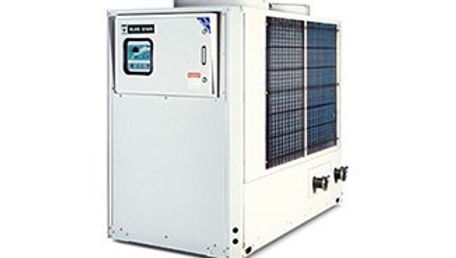
A chiller is a large-scale system that cools equipment or spaces by removing heat from a liquid, typically water, and circulating it through a heat exchanger. This chilled liquid absorbs heat from a process or air to lower its temperature. Chillers are categorized by how they reject heat (air-cooled or water-cooled) and by the type of compressor they use (centrifugal, screw, scroll).
How Chillers Work (Vapor-Compression Cycle)
Compression:A compressor increases the temperature and pressure of a refrigerant gas.
Condensation:The hot, high-pressure refrigerant flows through a condenser, where it releases heat and liquefies.
Expansion:The liquid refrigerant then goes through an expansion valve, where its pressure and temperature drop significantly.
Evaporation:The cold, low-pressure refrigerant enters an evaporator, where it absorbs heat from the liquid coolant (like water), becoming a gas again and completing the cycle.
Types of Chillers
Chillers are broadly classified by their heat rejection method:
Air-Cooled Chillers:Use ambient air as the heat rejection medium, often employing fans to disperse heat away from the system.
Water-Cooled Chillers:Use water as a cooling medium, circulating it to a cooling tower to release the absorbed heat into the atmosphere.
Evaporative-Cooled Chillers:Another method of heat rejection, often incorporating both air and water principles.
Key Components
Compressor: Compresses the refrigerant.
Condenser: Cools the refrigerant, causing it to condense into a liquid.
Expansion Valve: Reduces the refrigerant's temperature and pressure.
Evaporator: The component where the refrigerant absorbs heat from the liquid coolant, producing the chilling effect.
Applications
HVAC: Providing air conditioning for large buildings and commercial spaces.
Industrial Processes: Cooling machinery and process fluids in industries like electroplating, metal finishing, and food processing.
Data Centers: Regulating temperature to prevent overheating of sensitive equipment.